Aircond Water Leaking: Common Causes and How to Fix Them
Water dripping from your AC? Learn the top causes of aircond leaks in Malaysia and whether you can DIY fix or need professional repair.
[AddInfographic]
Why Is Your Aircond Leaking? (It’s Likely Not Broken)
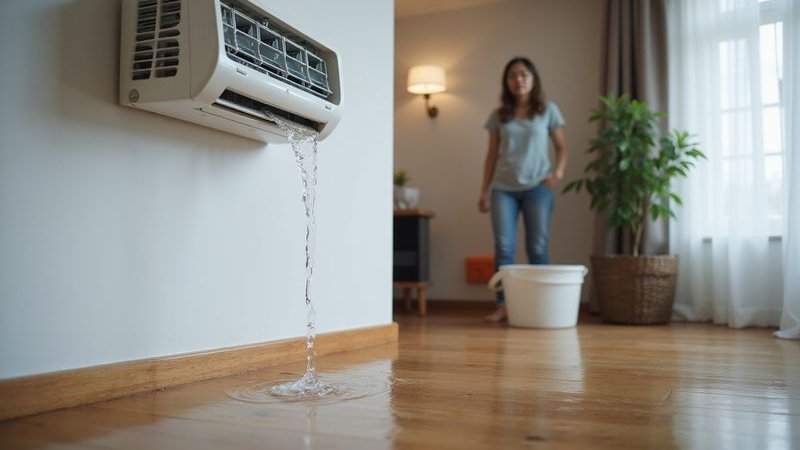
Water dripping from your air conditioner is easily the most frustrating issue we encounter in Kepong and Kuala Lumpur.
We see homeowners panic because they assume the unit is broken, but in 90% of cases, it’s just a maintenance issue.
Here is the reality of living in Malaysia: Our average outdoor humidity hovers around 80% year-round.
Your air conditioner works hard to remove that moisture, often extracting 10 to 20 liters of water per day from the air in a single room.
That water has to go somewhere.
It normally drips into a drainage tray and flows out through a pipe.
When that simple pathway gets blocked or tilted, gravity takes over, and the water ends up on your wall or expensive flooring.
We are going to break down exactly why this happens and help you decide if you can fix it yourself or if you need a pro.
The 6 Most Common Causes of Aircond Leaks
1. The “Biofilm” Blockage (Clogged Drain Line)
This is the culprit in nearly 70% of the service calls we attend.
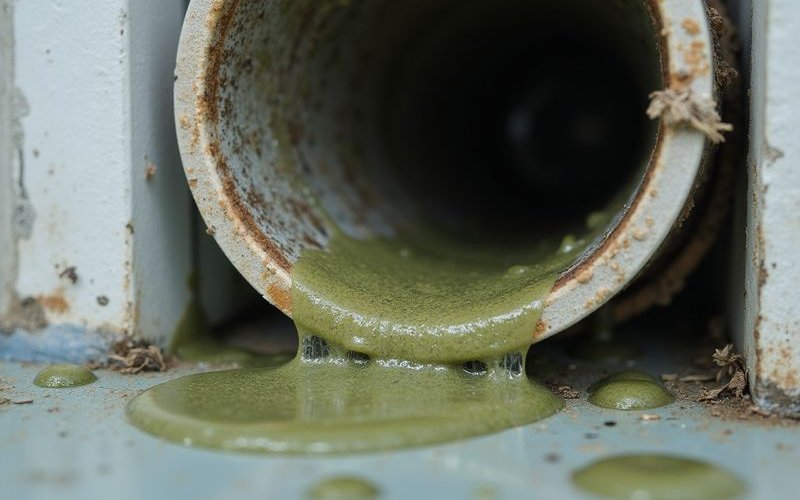
Most people think it’s just dust clogging the pipe, but it is actually something called biofilm (often nicknamed “jelly” or “snot”).
Bacteria thrive in the dark, wet environment of your drain pipe, creating a slimy protective layer that eventually blocks the water flow completely.
Signs to look for:
- Water backing up and dripping from the front of the indoor unit.
- A “glugging” sound coming from the unit before the leak starts.
- A faint, musty smell that indicates stagnant water.
The Insider Tip: Pouring plain water won’t clear biofilm because the slime is sticky.
DIY fix:
- Locate your drain hose outside (it’s usually a small white or grey PVC pipe).
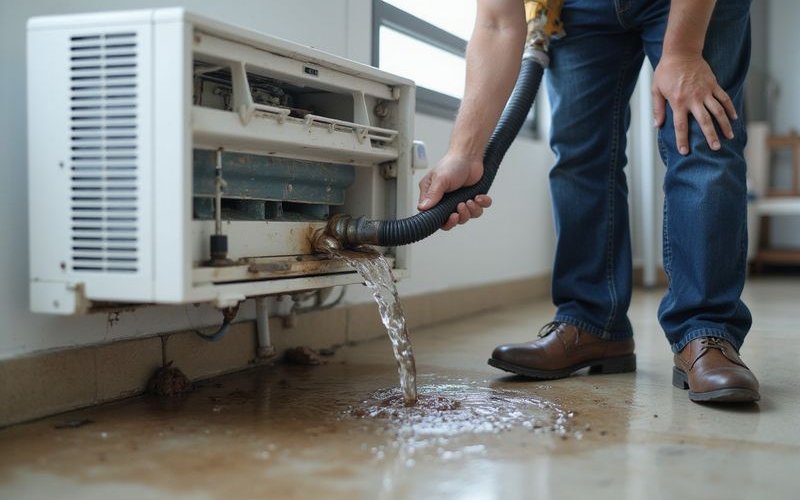
- Use a wet/dry vacuum to suck the blockage out from the outdoor end (never blow air in, or you’ll push the sludge back into your room).
- Pour a mixture of warm water and a small amount of dish soap into the indoor unit’s tray to flush the remaining slime.
When to call a pro: If the blockage is deep inside the wall or if the “jelly” returns within a few weeks.
2. Dirty Air Filters & The “Ice Block” Effect
We cannot stress this enough: a dirty filter does more than just ruin your air quality.
When dust completely coats the filter, it chokes the airflow.
This causes the evaporator coil to get too cold because there is no warm air passing over it to keep it regulated.
The moisture on the coil then freezes into a block of ice.
Once you turn the unit off, that ice melts rapidly—too fast for the drain pan to handle—and overflows onto your floor.
Signs:
- Ice visible on the black fins behind the filter.
- The unit blows warm air or has very weak airflow.
- Sudden gushing of water 10-15 minutes after you turn the AC off.
Prevention: In Kuala Lumpur’s dusty urban environment, we recommend cleaning filters every 2 weeks.
3. Low Refrigerant (Gas Leak)
Many older units in Malaysia (especially those using R22 gas) develop tiny pinhole leaks over time.
Newer models using R32 or R410A are more robust but can still leak due to vibration or poor welding.
Low gas pressure causes the coil to freeze over, just like a dirty filter does.
Signs:
- A hissing sound near the indoor unit.
- The air isn’t cold, even on the lowest setting (e.g., 16°C).
- Your TNB bill is suddenly higher because the compressor never turns off.
Professional solution: This is not a DIY fix. You need a technician to identify the leak source, repair the copper pipe, and then top up the gas.
4. Cracked or Rusted Drain Pan
The drain pan sits directly underneath your cold coils to catch the dripping water.
We often see older units (8+ years old) with metal pans that have rusted through.
Newer brands like Daikin and Panasonic use plastic pans, which don’t rust but can crack if the unit was installed under stress or hit during a previous service.
Signs:
- Water dripping from the back or corners of the unit, not just the front.
- Yellowish or brownish stains on the wall below the unit (rust indicators).
Professional solution: The entire unit usually needs to be dismantled to replace the pan.
5. Improper Installation Slope
Water relies on gravity to drain.
If your installer didn’t follow the standard 1% slope rule (dropping about 1/8 inch per foot of pipe), water will pool inside the pipe.
We frequently see this in new condo renovations where aesthetics were prioritized over function, and the pipe runs too flat inside the plaster ceiling.
Signs:
- The unit has leaked since the very first week of installation.
- Water leaks only when it rains heavily (sometimes due to backflow pressure).
DIY fix: Check the unit with a spirit level; if it’s perfectly flat or tilted backward, it needs re-hanging.
6. Frozen Evaporator Coil (The Thaw Flood)
This is often a symptom of other problems, but it deserves its own mention because of the volume of water involved.
A solid block of ice on your coil can hold over a liter of water.
When it melts, it overwhelms the shallow drain tray instantly.
Signs:
- Crackling sounds (ice expanding/contracting) inside the unit.
- Visible frost on the copper pipes connecting to the outdoor unit.
Quick Diagnosis Guide
Use this table to narrow down your problem before you call for help.
| Symptom | Likely Cause | Urgency |
|---|---|---|
| Dripping from front | Clogged drain (Biofilm) | Medium |
| Ice on unit | Low gas or dirty filter | High |
| Leaking from back | Installation slope issue | Medium |
| Water inside casing | Cracked drain pan | High |
| Intermittent dripping | Frozen coil thawing | High |
DIY Fixes You Can Try Today
Clear the Drain Line with Suction
What you need: A wet/dry vacuum (or a strong household vacuum with a water trap).
Steps:
- Turn off the aircond at the main switch.
- Find the drain outlet outside (usually near the compressor).
- Place the vacuum hose over the end of the drain pipe.
- Run the vacuum for 1 minute to suck out the slime and debris.
- Test by pouring a cup of water into the indoor unit’s filter area (carefully!).
Deep Clean Your Filters
What you need: Water, mild dish soap (avoid harsh chemicals), soft brush.
Steps:
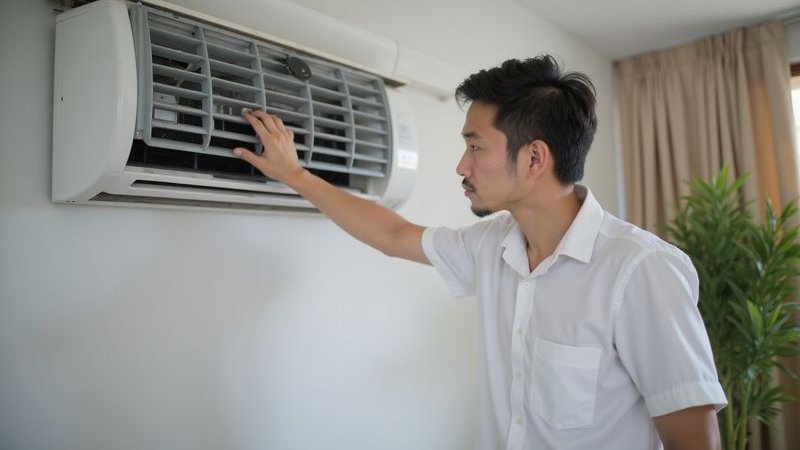
- Open the front cover and slide out the mesh filters.
- Wash them gently in the sink.
- Crucial Step: Let them air dry in the shade. Direct sun can warp the plastic frame, causing gaps that let dust bypass the filter later.
- Snap them back in securely.
When to Call a Professional
You should stop troubleshooting and get expert help if:
- Water is near electrical points: This is a serious fire hazard.
- The unit is frozen solid: chipping the ice can puncture the delicate copper coils.
- You live in a high-rise: and the drain pipe is inaccessible or hidden in a false ceiling.
- The leak persists: after you have cleaned the filters and vacuumed the drain.
Preventing Future Leaks
Regular maintenance is cheaper than repairing water-damaged parquet flooring.
We recommend this schedule for Malaysian homes:
| Task | Frequency | Who Does It? |
|---|---|---|
| Clean filters | Every 2 weeks | DIY |
| Check drain line | Monthly | DIY |
| General Service | Every 3-4 months | Pro |
| Chemical Wash | Yearly | Pro |
2026 Cost of Repair in Malaysia
Prices have adjusted slightly with the new year. Here is what you can expect to pay for reputable service in the KL/Selangor area.
Avoid “too good to be true” offers (e.g., RM30 servicing) as they often lead to hidden charges later.
| Issue | Typical Cost (2026) |
|---|---|
| General Service (Cleaning) | RM80 - RM120 |
| Chemical Wash (Overhaul) | RM130 - RM180 |
| Gas Top-up (R32/R410A) | RM80 - RM150 |
| Drain Pan Replacement | RM180 - RM350 |
| Troubleshooting/Checking | RM50 - RM80 |
Money-saving tip: A yearly chemical wash (approx. RM150) removes the biofilm that causes 70% of leaks. It effectively pays for itself by preventing emergency repairs and keeping your electricity efficiency high.
The Bottom Line
You don’t always need a technician for a leaky aircond, but you do need to act fast.
We find that most leaks are just simple drainage clogs caused by our humid Malaysian weather.
Start by cleaning your filters and checking the outdoor drain pipe.
If those two steps don’t stop the water, the issue is likely internal and requires tools you might not have.
Water leaking won’t stop? Contact AC Service Pro at 012-2252 623 for same-day diagnosis and repair in Kepong and surrounding areas.
Tags
AC Service Pro Team
Our team of experienced HVAC technicians shares practical tips to help you maintain your aircond and save on energy costs.
Ask Us a Question