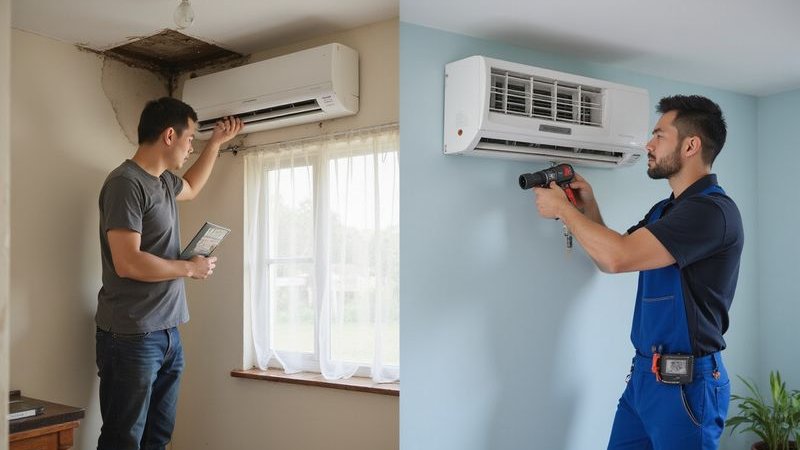
Aircond Repair: DIY vs Hiring a Professional?
Should you attempt to fix your AC yourself or call a technician? Compare costs, risks, and when DIY makes sense versus professional repair.
[AddInfographic]
Aircond Repair: DIY vs Hiring a Professional?
We see it every day in Kepong and Kuala Lumpur—a frantic call because an air conditioner stopped working right in the middle of a heatwave. The humidity here is relentless. It pushes cooling units to their breaking point faster than in drier climates. Our team knows that for many homeowners, the first instinct is to grab a ladder and see if they can fix it themselves to save a few Ringgit.
You might be surprised to learn that we actually encourage this for certain tasks. There is a distinct line between smart maintenance and dangerous repairs. From what we have observed servicing thousands of local units, knowing this difference is the key to saving money without risking injury or property damage.
We are going to clarify exactly what you can handle, what requires a licensed technician, and the specific cost breakdown for 2026.
What You CAN Fix Yourself
Good news: some AC maintenance and minor fixes are completely DIY-friendly. We recommend every homeowner master these simple tasks to keep their units running efficiently between professional services.
1. Cleaning Air Filters
Difficulty: Easy Tools needed: None (or a soft brush) Time: 15 minutes
Dirty filters are the cause of many cooling problems, especially with the construction dust common around the Klang Valley. A clogged filter restricts airflow, forcing your compressor to work double-time.
- Turn off the unit at the wall switch.
- Lift the front cover gently until it clicks open.
- Slide out the mesh filters.
- Wash them with water (use mild soap if they feel greasy).
- Dry them completely in a shaded area before reinstalling.
Pro Tip: Do this every 2 weeks during heavy use. We find that gel-type chemical cleaners are unnecessary for filters—plain water works best.
2. Clearing the Outdoor Unit
Difficulty: Easy Tools needed: Garden hose, soft brush Time: 30 minutes
Debris-blocked outdoor units reduce efficiency significantly. The “fins” on the back of the compressor need to breathe to release heat.
- Turn off the AC at the isolator switch (safety first).
- Remove leaves, dried mud, and debris from around the base.
- Gently hose down the fins using low pressure.
- Clear vegetation or potted plants within 2 feet of the unit.
Warning: Never use a high-pressure jet wash here. It can bend the delicate aluminum fins, which permanently ruins airflow.
3. Basic Drain Line Cleaning
Difficulty: Easy to Medium Tools needed: Wet/dry vacuum, “Pan Tablets” (optional) Time: 30 minutes
In our humid climate, a jelly-like algae biofilm often forms in drain pipes, causing water to back up and leak. This “jelly” is the number one cause of water leaking from indoor units in Malaysia.
- Locate the drain outlet (usually in your bathroom floor trap or balcony).
- Use a wet/dry vacuum to suck debris out from the end of the pipe.
- Test by slowly pouring a cup of water into the indoor unit’s drain tray.
Insider Trick: You can buy “condensate drain pan tablets” online or at hardware shops. Placing one in the tray prevents that algae jelly from growing for months.
4. Diagnostic Error Checks
Difficulty: Easy Tools needed: Your remote control Time: 5 minutes
Before you call us, you can often find out exactly what is wrong using your remote. This feature is built into most modern units like Panasonic and Daikin but is rarely explained in the manual.
- For Panasonic: Use a pin to press “Check” or hold the “Timer” down button until the display blinks.
- For Daikin: Hold the “Cancel” button for 5 seconds until “00” blinks, then click it repeatedly until you hear a long beep.
We suggest writing down this code (e.g., H11, U4). It helps technicians bring the right parts immediately.
5. Resetting the Unit
Difficulty: Easy Tools needed: None Time: 5 minutes
Many error codes, especially after a thunderstorm or power surge, clear after a hard reset:
- Turn off the AC at the main isolator or DB box.
- Wait 5-10 minutes to let the capacitors discharge.
- Turn it back on.
What You Should NEVER DIY
Some repairs require professional training, tools, and licensing. We strictly advise against attempting these because the risk of injury and property damage is too high.
1. Refrigerant (Gas) Work
Why not DIY:
- Handling refrigerants like R32 or R410A requires certification under Malaysian environmental regulations.
- These systems operate under immense pressure (often exceeding 300 PSI).
- You cannot properly diagnose a leak without digital manifold gauges.
- “Topping up” gas without fixing the leak first is a waste of money.
The risk: Frostbite burns, blindness from pressurized gas, and fines for improper environmental release.
2. Electrical Repairs (Capacitors & Wiring)
Why not DIY:
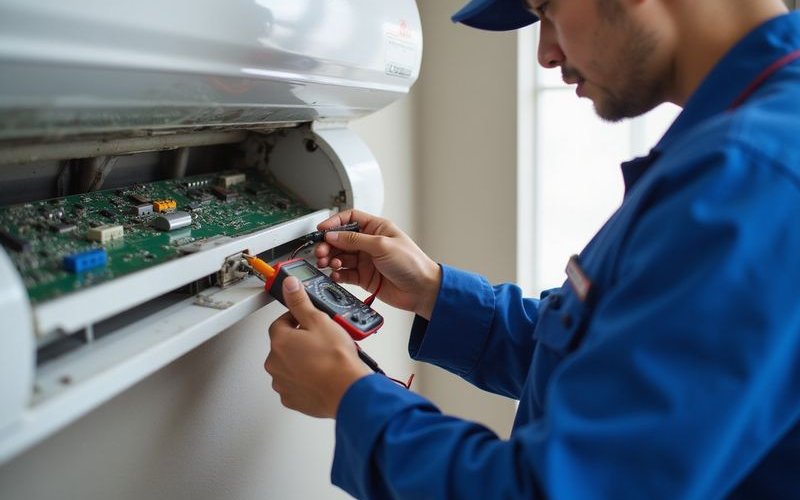
- AC capacitors store high-voltage electricity even when the power is off.
- Improper wiring at the terminal block can melt the casing or cause a fire.
- Malaysian homes use 240V mains, which is lethal if mishandled.
The risk: Severe electrocution, house fires, and voiding your home insurance policy.
3. Chemical Overhaul (“Chemical Wash”)
Why not DIY:
- Store-bought “spray-on” cleaners often fail to rinse out completely.
- Leftover chemical residue corrodes the cooling coils, leading to gas leaks within a year.
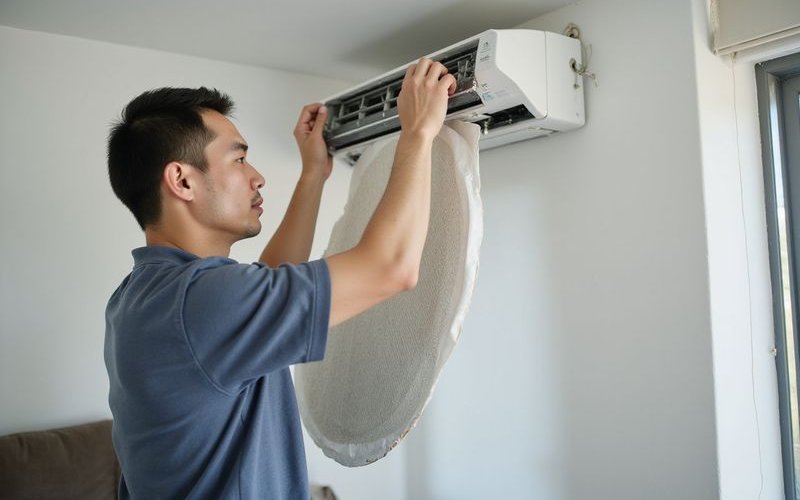
- A proper chemical wash requires dismantling the unit and using a canvas bag to catch the runoff.
The risk: Destroying the cooling coil and damaging the wall paint or parquet flooring below.
4. Internal Component Replacement
Why not DIY:
- Fan motors and PCBs (boards) must be exact model matches.
- Universal parts from Jalan Pasar often don’t communicate correctly with the inverter system.
- Improper installation can cause cascading failures that fry the main motherboard.
The risk: Turning a RM300 repair into a RM1,500 total unit replacement.
Cost Comparison (2026 Estimates)
Prices in the Klang Valley have adjusted due to labor and material costs. We have compiled this table to help you weigh the financial risks.
| Task | DIY Cost | Professional Cost | Risk Level |
|---|---|---|---|
| Filter Cleaning | RM0 | RM30-50 | None |
| Drain Cleaning | RM20 (Tablets) | RM80-120 | Low |
| Gas Top-up (R32) | Not possible | RM100-180 | N/A |
| General Service | RM50 (Tools) | RM80-150 | Medium |
| Chemical Wash | RM30 (Spray) | RM150-300 | High (Corrosion) |
| Capacitor Change | RM30-50 (Part) | RM180-250 | Dangerous |
| Compressor Repair | Not possible | RM900-2000+ | N/A |
Key insight: The “Professional Cost” for a basic service is often less than the price of a single broken plastic cover. Our data shows that safe DIY maintenance is about prevention, not repair.
The Real Risks of DIY Repair
Condo Management Fines
Under the Strata Management Act 2013, management bodies can fine owners for unauthorized work that affects common property. We have seen homeowners fined for dripping water onto neighbors’ balconies or leaving debris in corridors.
Voiding Your Warranty
Most AC warranties (Daikin, Panasonic, Acson) explicitly require proof of professional servicing. DIY repairs—especially those involving the casing or internal parts—will almost certainly void your remaining warranty coverage.
Making It Worse
Without proper diagnosis, you might fix the wrong thing. We regularly see units where a homeowner replaced a sensor, but the root cause was actually a dirty coil. The unit continued to overheat until the compressor failed.
Hidden Problems
Professionals diagnose root causes, not just symptoms. You might clear a drain clog temporarily, but a pro would notice the unit is tilted at the wrong angle, which is why it clogged in the first place.
When DIY Makes Sense
✅ Regular maintenance: Filter cleaning, clearing leaves from the outdoor unit. ✅ Basic troubleshooting: Power resets, checking remote batteries. ✅ Minor issues: Using a vacuum to clear accessible drain clogs. ✅ Between professional services: Keeping the exterior and vents dust-free.
When to Call a Professional
❌ Error codes blinking on the unit (e.g., Timer light flashing). ❌ Poor cooling even after you have cleaned the filters. ❌ Water leaking from the back of the unit (requires dismantling). ❌ Strange sounds: Grinding, squealing, or loud banging. ❌ Burning smell or visible smoke (Turn off immediately!). ❌ Ice formation on the copper pipes (Indicates a gas leak or blockage). ❌ Annual maintenance: Full chemical overhaul or gas pressure check.
The Smart Approach
The most cost-effective strategy combines your diligence with our technical expertise. This partnership extends the life of your unit by years.
Your Routine (DIY)
| Task | Frequency |
|---|---|
| Clean filters | Every 2 weeks |
| Check drain flow | Monthly |
| Clear outdoor unit | Monthly |
| Visual inspection | Monthly |
Professional Service Schedule
| Service | Frequency |
|---|---|
| Standard service | Every 4-6 months |
| Chemical wash | Annually (or if airflow is weak) |
| Gas check | With chemical wash |
The math: Regular maintenance costs roughly RM300-400 per year. Replacing a neglected compressor or buying a new unit costs RM1,500-2,500.
Questions to Ask Before DIY
Before attempting any repair, ask yourself these four questions:
-
Do I understand the error code? If the light is blinking, look up the code first. If it indicates a sensor or board failure, put the tools away.
-
Do I have the right equipment? Improvising with pliers instead of a wrench often strips nuts and bolts.
-
What happens if I break it? If breaking the part means you have no AC for a week while waiting for a shipment, call a pro who has the part in their van.
-
Is my safety at risk? If the task involves opening the electrical box or hanging out a window, it is never worth the risk.
The Bottom Line
DIY: Stick to cleaning filters, clearing the outdoor area, and basic resets. Professional: Call for anything involving gas, water leaks, electrical parts, or strange noises. Our professional AC repair service handles all these issues safely.
The goal isn’t to eliminate professional service—it’s to reduce how often you need expensive emergency repairs. Good DIY maintenance makes professional services routine check-ups rather than costly rescues.
Not sure if it’s a DIY fix? Send us a WhatsApp at 012-2252 623 with a description or photo. We’ll tell you honestly if it’s something you can handle yourself.
Tags
AC Service Pro Team
Our team of experienced HVAC technicians shares practical tips to help you maintain your aircond and save on energy costs.
Ask Us a Question